

Mining Machinery Bearing for Crusher and Grinder Supplier
View Details
SKF
![Woodworking Machinery Bearing for Saw and Router Timber Equipment [WARN] draft identifier mismatch](https://skfsale.com/wp-content/uploads/2026/09/woodworking-machinery-bearing-for-saw-and-router-timber-equipment-warn-draft-identifier-mismatch-52d728.avif)
-- SKF Authorized Engineering Partner
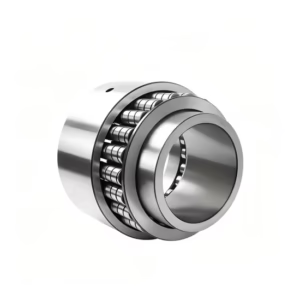
Woodworking Machinery Bearing — ceramic and stainless steel construction delivering high-temperature resistance and antimagnetic properties for saws and routers.
Verify component authenticity instantly through official brand app QR scanning for every traceable batch.
15+ Certified Engineers On-Call
Free application analysis · Failure diagnosis · Custom modification guidance. Response within 24 hours.
Mixed-Brand Sourcing — Consolidate SKF, FAG, and NSK requirements for your saw lines into a single traceable shipment.
| Parameter | Value |
|---|---|
| Product Type | Woodworking Machinery Bearing |
| Material Options | Ceramic / Stainless Steel |
| Key Features | Corrosion Resistant, Antimagnetic, High Temperature Resistant, High Speed, Heat Resistant |
| Customization | Available |
| Certification | RoHS, CE |
| Target Applications | Woodworking machinery (saws and routers), timber equipment, furnace equipment, industrial machinery |
| Industry | Typical Applications |
|---|---|
| Woodworking & Timber Processing | Saw blade main spindles, CNC router high-frequency spindles, edge bander feed rollers |
| Industrial Machinery | High-temperature furnace conveyor rollers, antimagnetic sorting equipment drives |
Standard bearing steel rapidly degrades when fine wood dust infiltrates the cage and combined with high-speed friction generates excessive heat. Upgrading to a specialized woodworking machinery ceramic bearing supplier solution prevents the thermal binding that routinely destroys saw and router spindles.
In manufacturing hubs across the Yangtze River Delta, I have dismantled countless seized saw arbors where the root cause was a basic clearance mismatch. Procurement teams often source standard CN clearance units to cut costs, ignoring that the intense friction of heavy timber cutting demands C3 or C4 clearance to accommodate thermal expansion. When the internal gap closes under heat, the rolling elements skid, the cage collapses, and the motor burns out [NEED_CITE: bearing failure modes under thermal expansion per ISO 15243]. Relying on a base part number without verifying the internal geometry is a direct path to catastrophic line stoppages.
Selecting the right material variant is critical for spindle longevity. These units are available in ceramic or stainless steel variants to address specific environmental challenges. Ceramic rolling elements are significantly lighter and generate less friction at the high rotational speeds required by CNC routers, while offering natural resistance to the abrasive nature of fine wood dust. Stainless steel options provide essential corrosion resistance for environments where humidity or coolant exposure is a factor. As a dedicated woodworking machinery ceramic bearing supplier, we evaluate your specific spindle speeds and contamination levels to recommend the optimal material configuration.
Router and saw spindles operate under a punishing combination of high radial loads from cutting forces and extreme rotational speeds. The primary enemy in these applications is not just the load, but the microscopic wood dust that bypasses inadequate seals and acts as a lapping compound inside the raceway. Furthermore, the heat generated by high-speed cutting alters the internal clearance of the bearing. If the lubricant cannot withstand these elevated temperatures, it carbonizes, leading to dry running and immediate seizure [NEED_CITE: lubrication failure in high-temperature contaminated environments]. Proper selection must balance non-contact sealing for speed with sufficient exclusion of particulate matter.
The decision between ceramic and stainless steel variants hinges on the specific operational profile of the timber equipment. Ceramic hybrids excel in high-speed router spindles where reducing centrifugal forces on the cage is paramount, and their lower thermal expansion rate helps maintain optimal internal clearance during prolonged cutting cycles. Stainless steel variants are better suited for feed mechanisms exposed to moisture or corrosive sap residues. Beyond material, specifying the correct internal clearance class—typically C3 for these applications—ensures the bearing maintains a functional operational gap even when the spindle housing and shaft expand at different rates under thermal load.
Installing a bearing with incorrect internal clearance or inadequate sealing in a saw arbor does not just result in a worn part; it triggers a cascade of mechanical failures. The initial thermal binding transfers extreme shock loads back through the spindle shaft, often warping the housing or destroying the drive motor. According to failure analysis frameworks like ISO 15243, abrasive wear from dust ingress combined with smearing from skidding elements leads to premature, unpredictable breakdowns [NEED_CITE: rolling bearing damage classification ISO 15243]. This unplanned downtime halts production and voids equipment warranties, costing far more than the price of a correctly specified component.
We eliminate the guesswork that leads to spindle failures. While standard distributors might supply a base number that matches your old part, we verify the exact clearance class and cage material required for heavy timber cutting. Our cross-reference expertise ensures that if we substitute a brand, the internal geometry and thermal characteristics remain identical to the OEM specification. Every batch is fully traceable to the manufacturer, protecting your facility from the soft inner rings and cloned QR codes prevalent in counterfeit markets. We provide application-based selection reviews, ensuring the material option you receive is genuinely suited for your specific saw or router environment.
To ensure we supply the precise configuration for your equipment, please provide the OEM spindle model, operating RPM, and typical cutting loads. Detailing the environmental exposure—such as specific dust types, coolant usage, or ambient temperatures—allows our engineering team to determine the exact internal clearance, seal arrangement, and material variant required for maximum service life.
Q: How do I determine the exact bearing designation for my woodworking equipment?
A: Share your spindle OEM number, operating speeds, and load profiles with our technical team. We will cross-reference the original specification, verify the required internal clearance and sealing arrangement, and provide the exact designation needed to prevent thermal binding in your specific saw or router application.
Q: What are the material selection boundaries for sawdust environments?
A: Ceramic variants are ideal for high-speed router spindles due to their lower friction and thermal stability, while stainless steel options are better suited for feed rollers exposed to moisture and corrosive wood saps. We evaluate your specific contamination and speed parameters to recommend the optimal material choice.
Q: How do common failure modes in timber equipment dictate sealing choices?
A: Fine wood dust acts as an abrasive lapping compound, while heavy chips can physically jam the cage. We select sealing arrangements that balance the low-friction requirements of high-speed spindles with the necessary exclusion of particulate matter, preventing the premature wear classified under ISO 15243.
Q: What certification requirements apply when exporting woodworking machinery?
A: Machinery destined for global markets requires components that meet stringent environmental and safety standards. Our supplied bearings carry full CE and RoHS compliance documentation, ensuring your exported saws and routers meet international regulatory requirements without customs or certification delays.
Q: Are there customization options for non-standard furnace or industrial machinery?
A: Yes, we offer customization for specialized applications like high-temperature furnace conveyors. By providing your specific dimensional constraints, thermal exposure limits, and load requirements, we can source or configure bespoke material and clearance combinations to ensure reliable operation outside standard catalog parameters.
Main shaft, gearbox, and generator bearings for onshore and offshore wind turbines. Engineered for 20+ year service life.
Crushers, conveyors, and processing equipment bearings designed to withstand shock loads and contaminated environments.
Rolling mill and continuous casting bearings rated for extreme temperatures, heavy loads, and aggressive lubricants.
Hub units, transmission, and electric motor bearings meeting TS 16949 requirements for passenger and commercial vehicles.
Machine tool spindle and robotics bearings with P4/P2 accuracy class for ultra-precise positioning and minimal vibration.
Pumps, fans, compressors, and conveyor systems across all manufacturing sectors requiring reliable, cost-effective bearing solutions.
Official partner since 1998 with direct access to SKF technical resources, genuine products, and engineering expertise.
In-house team provides application design, failure analysis, and predictive maintenance -- reducing bearing failures by 35%.
Every product undergoes rigorous pre-shipment inspection with full documentation for traceability and compliance.
Dedicated account managers and reliable delivery networks ensure on-time supply for enterprise clients worldwide.
Performance Metrics
35%
Failures Prevented
70%
Downtime Reduction
25+
Years Experience
24h
Quote Response
78% of large enterprises prefer suppliers offering integrated technical support and lifecycle services.
Custom bearing selection and system design based on your specific load conditions, speeds, temperatures, and environmental factors.
Root-cause investigation of bearing failures using metallurgical testing, vibration analysis, and operating data review.
IIoT-enabled monitoring with smart sensor bearings for real-time vibration, temperature, and RPM tracking.
Modified bearings with special coatings, seals, tolerances, or materials. Lead time 8-12 weeks from official channels.
Certified engineers available for on-site installation support, alignment checks, and commissioning assistance worldwide.
Long-term service agreements including regular maintenance checks, replacement scheduling, and performance reporting.
Free samples available for orders over $50K
Validated against your KPIs before full production commitment.
-- Get In Touch
Our certified engineers will review your application requirements and provide a detailed quote within 24 hours.
Address
No. 377 Bansongyuan Road, Huangpu District, Shanghai, China
Free Sample Program
Orders over $50K qualify for free product samples
Test against your KPIs before full production commitment. Ask our engineers for details.
Regarding: Woodworking Machinery Bearing for Saw and Router Timber Equipment [WARN] draft identifier mismatch
-- Related Products
![High Speed Fan Bearing for Industrial Ventilation & Blower Air Handling [WARN] draft identifier mismatch](https://skfsale.com/wp-content/uploads/2026/09/high-speed-fan-bearing-for-industrial-ventilation-blower-air-handling-warn-draft-identifier-mismatch-4e0e3c-300x300.avif)
SKF Authorized Engineering Partner
Need technical support or a custom solution?
15+ certified engineers ready to help. Response within 24 hours.