

NSK Nup2203em Nup2204em Nup2205em Cylindrical Roller Bearing
View Details
SKF

-- SKF Authorized Engineering Partner
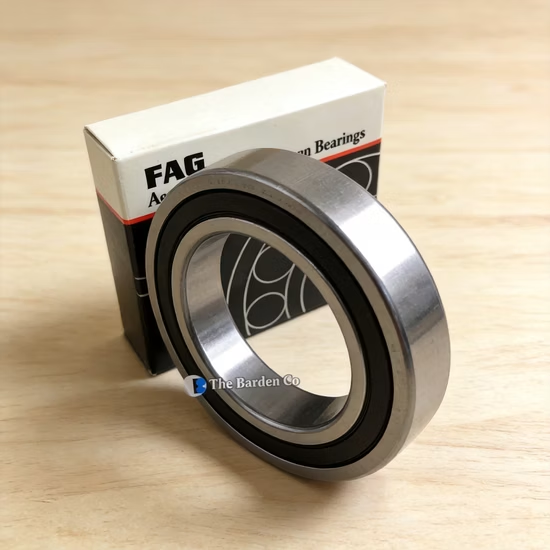
FAG HCB7203-C-T-P4S Angular Contact Ball Bearing 17 mm Bore — engineered with a 15° contact angle to effectively manage combined radial and axial loads in high-speed setups.
15+ Certified Engineers On-Call
Free application analysis · Failure diagnosis · Custom modification guidance. Response within 24 hours.
Precision Cross-Reference Alignment — We verify base numbers alongside cage materials and precision suffixes to prevent thermal binding in high-speed spindles.
| Parameter | Value |
|---|---|
| Designation | FAG HCB7203-C-T-P4S |
| Bearing Type | Angular Contact Ball Bearing |
| Bore Diameter (d) | 17 mm |
| Outside Diameter (D) | 40 mm |
| Width (B) | 12 mm |
| Number of Rows | Single Row |
| Contact Angle | 15° |
| Arrangement | Single bearing, adjustable or paired |
Note: Suffixes HCB, T, and P4S require manufacturer catalog confirmation for exact material, cage, and precision definitions beyond standard nomenclature.
| Industry | Typical Applications |
|---|---|
| Chemical Fiber Manufacturing | High-speed extrusion pump drives, spinning head metering mechanisms |
| Precision Machining | High-frequency motorized spindle nose bearings, precision grinding heads |
| Industrial Automation | High-speed robotic arm joint actuators, direct-drive rotary tables |
The failure usually stems from a microscopic clearance mismatch rather than a defective bearing.
In chemical fiber extrusion lines, the thermal gradient across the spindle housing is rarely uniform. I once investigated a catastrophic spindle seizure at a local synthetic fiber plant where the maintenance team replaced a worn bearing with a standard precision equivalent. The base designation matched perfectly, but the internal clearance and cage material did not account for the localized heat generation at sustained high speeds. As the inner ring expanded, the clearance vanished, leading to ceramic ball skidding and eventual cage disintegration [NEED_CITE: rolling bearing failure mode classification per ISO 15243]. Sourcing a genuine FAG HCB7203-C-T-P4S angular contact ball bearing eliminates the part number guesswork, provided the entire suffix string is rigorously validated against the original equipment requirements.
The 15° contact angle inherent to the C suffix in this FAG HCB7203-C-T-P4S angular contact ball bearing is specifically engineered to balance radial support with axial rigidity. In high-speed chemical fiber pumps, the axial thrust from fluid pressure is significant, but excessive axial stiffness can generate destructive friction heat. This specific contact geometry ensures smooth load transfer while minimizing the gyroscopic slip of the rolling elements, keeping the operating temperature well within the safe limits of the spindle lubrication system.
High-speed spindles in chemical fiber equipment operate under intense thermal stress and strict vibration limits. The primary challenge is maintaining a stable lubricant film when centrifugal forces push the grease or oil away from the raceway contact zones. At elevated temperatures, standard steel rolling elements expand considerably, altering the internal geometry and increasing friction. Furthermore, any contamination from the humid, chemically active environment of a fiber plant can rapidly degrade the lubricant. Selecting the correct precision class and cage material is critical to ensure the bearing survives these combined thermal and mechanical loads without suffering from lubrication starvation [NEED_CITE: thermal effects on bearing internal clearance and fatigue life per ISO 281].
The true capability of this bearing lies in its specialized suffix configuration. The C designation confirms the 15° contact angle, optimizing the load distribution for high-speed rotation. While standard P4 precision guarantees tight dimensional tolerances for spindle runout, the P4S suffix indicates a specialized precision tier often demanded by high-frequency motorized spindles to minimize vibration at peak RPM. The HCB and T suffixes denote advanced material and cage configurations—typically involving hybrid ceramic rolling elements and specialized high-speed cages—which drastically reduce centrifugal mass and friction heat. This combination ensures that the bearing maintains its geometric stability even when the spindle reaches its maximum operational velocity, preventing the thermal runaway that destroys standard angular contact bearings.
Purchasing a bearing based solely on the base number is a common trap that leads to severe operational disruptions. When a cross-reference ignores the cage material or precision suffix, the replacement might physically fit the housing but fail dynamically. A standard steel cage will generate excessive friction heat at the speeds required for fiber extrusion, leading to premature fatigue and unplanned downtime. Worse, incorrect precision classes can cause micro-vibrations that ruin the surface finish of the manufactured fiber and damage the spindle housing seating. According to failure analysis frameworks, a significant share of premature bearing failures in precision machinery traces back to these subtle specification mismatches rather than manufacturing defects [NEED_CITE: root cause analysis of premature bearing failures per ISO 15243].
Procuring critical spindle bearings requires absolute certainty in the supply chain. Our authorization across major international brands ensures that your FAG HCB7203-C-T-P4S angular contact ball bearing is sourced directly from the manufacturer’s production facilities, bypassing unauthorized gray-market channels. We do not just match the base designation; our technical team cross-references the exact clearance, cage material, and precision suffixes to guarantee functional equivalence. Every shipment is backed by comprehensive batch traceability, allowing you to verify the product’s origin and manufacturing history. This rigorous validation process protects your high-speed equipment from the devastating consequences of counterfeit bearings with soft inner rings and cloned packaging.
To ensure the selected bearing perfectly matches your spindle requirements, please provide the specific radial and axial loads, maximum operating speed, and typical thermal profile of your application. Sharing the original equipment manufacturer’s part number or the exact housing dimensions allows our engineering team to perform a comprehensive cross-reference check. This technical review ensures that the clearance and precision suffixes are fully optimized for your specific chemical fiber or machining environment, preventing costly selection errors.
Q: How do I verify the authenticity of the FAG HCB7203-C-T-P4S angular contact ball bearing?
A: Authenticity is confirmed by scanning the QR code on the packaging using the manufacturer’s official mobile application. Additionally, we provide a Certificate of Conformity and batch traceability documents that link the specific bearing to its original production run, ensuring it is not a counterfeit with cloned codes or soft inner rings.
Q: Why is it critical to match the exact suffixes during cross-referencing?
A: Base numbers only define the physical dimensions. Suffixes dictate the contact angle, cage material, and precision class. In high-speed spindles, ignoring these details can lead to thermal binding or cage failure. We verify every suffix to ensure the replacement handles your specific speed and thermal loads.
Q: What distinguishes the P4S precision class from standard P4?
A: While P4 defines standard high-precision tolerances, P4S often indicates specialized tolerances optimized for ultra-high-speed spindles, particularly regarding runout and thickness variation. Because P4S is an unverified suffix in standard public tables, we always confirm its exact definition with the manufacturer’s current catalog to ensure proper application.
Q: How does the 15° contact angle benefit chemical fiber equipment?
A: The 15° contact angle, denoted by the C suffix, provides an optimal balance between radial load capacity and axial stiffness. This geometry minimizes friction heat generation at high rotational speeds, which is crucial for maintaining dimensional stability in precision chemical fiber extrusion and spinning mechanisms.
Main shaft, gearbox, and generator bearings for onshore and offshore wind turbines. Engineered for 20+ year service life.
Crushers, conveyors, and processing equipment bearings designed to withstand shock loads and contaminated environments.
Rolling mill and continuous casting bearings rated for extreme temperatures, heavy loads, and aggressive lubricants.
Hub units, transmission, and electric motor bearings meeting TS 16949 requirements for passenger and commercial vehicles.
Machine tool spindle and robotics bearings with P4/P2 accuracy class for ultra-precise positioning and minimal vibration.
Pumps, fans, compressors, and conveyor systems across all manufacturing sectors requiring reliable, cost-effective bearing solutions.
Official partner since 1998 with direct access to SKF technical resources, genuine products, and engineering expertise.
In-house team provides application design, failure analysis, and predictive maintenance -- reducing bearing failures by 35%.
Every product undergoes rigorous pre-shipment inspection with full documentation for traceability and compliance.
Dedicated account managers and reliable delivery networks ensure on-time supply for enterprise clients worldwide.
Performance Metrics
35%
Failures Prevented
70%
Downtime Reduction
25+
Years Experience
24h
Quote Response
78% of large enterprises prefer suppliers offering integrated technical support and lifecycle services.
Custom bearing selection and system design based on your specific load conditions, speeds, temperatures, and environmental factors.
Root-cause investigation of bearing failures using metallurgical testing, vibration analysis, and operating data review.
IIoT-enabled monitoring with smart sensor bearings for real-time vibration, temperature, and RPM tracking.
Modified bearings with special coatings, seals, tolerances, or materials. Lead time 8-12 weeks from official channels.
Certified engineers available for on-site installation support, alignment checks, and commissioning assistance worldwide.
Long-term service agreements including regular maintenance checks, replacement scheduling, and performance reporting.
Free samples available for orders over $50K
Validated against your KPIs before full production commitment.
-- Get In Touch
Our certified engineers will review your application requirements and provide a detailed quote within 24 hours.
Address
No. 377 Bansongyuan Road, Huangpu District, Shanghai, China
Free Sample Program
Orders over $50K qualify for free product samples
Test against your KPIs before full production commitment. Ask our engineers for details.
Regarding: FAG HCB7203-C-T-P4S Angular Contact Ball Bearing for Chemical Fiber Equipment
-- Related Products


SKF Authorized Engineering Partner
Need technical support or a custom solution?
15+ certified engineers ready to help. Response within 24 hours.