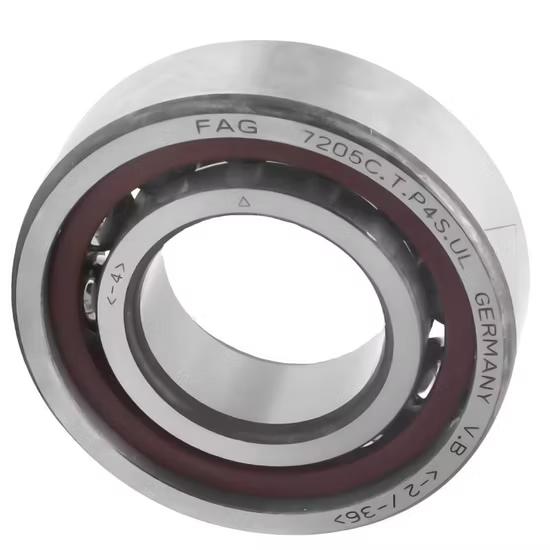
Cross-reference alignment verified — We strictly match clearance, cage material, and precision suffixes during interchange to prevent thermal binding in high-speed spindles.
Technical Specifications
| Parameter |
Value |
| Product Type |
Angular Contact Ball Bearing |
| Material Options |
High-carbon chromium bearing steel, martensitic stainless steel, or hybrid ceramic variants |
| Cage Options |
Machined brass, phenolic resin, or polyamide |
| Precision Classes |
P4, P2, SP, UP |
| Contact Angle Options |
15°, 25°, or 40° |
| Origin |
China |
Application Suitability
| Industry |
Typical Applications |
| Machine Tool Manufacturing |
High-speed motorized spindles, ball screw support units, and rotary tables |
| Robotics & Automation |
Joint actuators, precision gearboxes, and automated guided vehicle steering |
| Fluid Machinery |
High-speed pump shafts and compressor rotors |
| Precision Equipment |
Optical measuring instruments and semiconductor manufacturing stages |
Why Spindle Vibration Spikes Even With the Correct Base Number
Sourcing from a reliable high precision angular contact ball bearing supplier means looking far beyond the base designation to prevent catastrophic thermal seizure.
Matching the base number while ignoring internal design suffixes is a primary cause of premature spindle failure.
Early in my career transitioning from quality inspection to trade in the Pearl River Delta, I investigated a batch of bearings that caused severe vibration and unexpected downtime in a CNC machining center. The base designation was correct, but the precision grade and clearance were entirely wrong for the high-speed application. When a standard precision bearing is forced into a high-speed spindle, the internal heat generation rapidly exceeds the thermal expansion limits of the chosen clearance. This leads to negative internal clearance, excessive preload, and ultimately, cage failure or ring seizure [NEED_CITE: rolling bearing failure mode classification per ISO 15243]. Procurement teams often focus solely on the numeric identifier, overlooking the critical suffix combinations that dictate how the bearing behaves under extreme rotational speeds and thermal gradients.

Engineering the Match for High-Speed Rotary Axes
Selecting the right component for a motorized spindle requires balancing rotational velocity with axial stiffness. As a specialized high precision angular contact ball bearing supplier, we review the specific speed factor and axial load requirements to recommend the optimal contact angle and preload arrangement. A 15-degree contact angle generally favors extreme speed with moderate axial loads, while a 25-degree or 40-degree angle provides the necessary rigidity for heavier cutting forces. We ensure the selected configuration aligns perfectly with the spindle manufacturer’s original dynamic stiffness requirements.
Navigating Thermal and Lubrication Extremes
High-speed spindles generate immense frictional heat at the rolling element and raceway contact zones. The choice between oil-air lubrication and grease dictates the required cage material and internal geometry. Phenolic resin cages are often preferred for oil-air systems due to their low friction and high-speed stability, while machined brass offers superior durability under heavier loads or less optimal lubrication conditions. Furthermore, the operating temperature directly impacts the internal clearance; a standard clearance will close up dangerously as the inner ring expands faster than the outer ring [NEED_CITE: thermal expansion effects on bearing internal clearance per ISO 281]. Selecting the correct initial clearance class is non-negotiable to maintain a stable operating preload.
Decoding Material and Cage Configurations
The internal architecture defines the operational boundaries of these components. Hybrid variants, utilizing silicon nitride ceramic rolling elements, are available for applications demanding extreme speeds and electrical insulation, as the ceramic material is noticeably lighter and reduces centrifugal forces on the outer raceway. Cage selection is equally critical: machined brass cages provide excellent vibration damping and structural integrity under heavy axial loads, whereas polyamide or phenolic cages minimize friction and heat generation at the upper limits of the speed rating. Precision classes such as SP or UP guarantee the tight dimensional and running accuracy tolerances required to maintain sub-micron spindle runout, ensuring the final machined parts meet strict surface finish specifications.
The Hidden Toll of Specification Mismatches
Installing a bearing that meets the dimensional envelope but lacks the correct precision or clearance specifications leads to severe operational penalties. Unplanned downtime occurs when the spindle overheats and seizes, halting the entire production line. Catastrophic damage often extends beyond the bearing itself, scoring the expensive spindle shaft and housing, which multiplies the repair costs significantly. Furthermore, utilizing unverified or incorrectly specified components typically results in immediate warranty voidance from the machine tool builder [NEED_CITE: warranty implications of non-OEM specified components]. The financial impact of a single spindle rebuild far outweighs the initial procurement savings of an incorrectly specified part.
Securing Your Supply Chain Against Interchange Errors
Our technical review process specifically targets the high-risk areas of cross-brand substitution in precision applications. When substituting across brands, we verify that the contact angle, cage material, and preload arrangements are identical, preventing the common error of installing a standard clearance part where a restricted clearance was engineered for spindle rigidity. We provide comprehensive cross-referencing that accounts for the nuanced differences in how various manufacturers designate their high-speed series. Every shipment is backed by authorized distribution channels, ensuring you receive genuine products with full batch traceability rather than visually identical counterfeits with soft inner rings that fail under load.
Documentation & Authenticity
- Certificate of Conformity verifying the specific precision class and contact angle.
- Batch and lot traceability linking the physical product to the manufacturer’s production records.
- Official app QR verification for instant authenticity checks on the shop floor.
- Material test reports confirming the metallurgical grade of the rings and rolling elements.
- Dimensional and running accuracy inspection reports validating SP or UP tolerances prior to dispatch.
- Country-of-origin documentation for customs compliance and project bidding requirements.
Storage, Handling & Mounting Protocols
- Retain original vacuum packaging until mounting to prevent moisture ingress that compromises high-precision raceway finishes.
- Store in a climate-controlled environment to prevent thermal cycling from degrading the phenolic or polyamide cage materials.
- Use dedicated, clean lint-free gloves when handling to prevent skin acids from etching the high-carbon chromium steel surfaces.
- Employ precise induction heating with strict temperature limits to avoid altering the metallurgical structure of the precision inner ring.
- For hybrid ceramic variants, use non-marring tools to prevent micro-fractures on the brittle silicon nitride rolling elements.
- Verify the high-point marks on matched sets to ensure the correct phase alignment during spindle assembly.
Initiating Your Technical Review
To ensure the selected configuration meets your exact operational demands, please provide the specific machine tool model, spindle operating speeds, and expected axial cutting forces. Our engineering team will utilize these parameters to calculate the required dynamic stiffness and recommend the optimal contact angle and preload arrangement. If you are replacing an existing unit, sharing the exact OEM equipment number and the operating environment details allows us to perform a rigorous cross-reference check, ensuring the replacement perfectly mirrors the original thermal and mechanical design intent.
Frequently Asked Questions
Q: How do we determine the exact designation and pairing arrangement for our spindle?
A: Provide your spindle’s maximum operating speed, axial and radial load profiles, and the required stiffness. Our engineering team analyzes these parameters to select the correct contact angle, cage material, and preload class. We then define the exact pairing arrangement, such as back-to-back or face-to-face, ensuring the final specification perfectly matches your machine’s dynamic requirements without risking thermal binding.
Q: Why is it critical to align clearance and precision suffixes during cross-referencing?
A: Base numbers often match across brands, but internal designs differ significantly. Installing a standard clearance bearing in a high-speed spindle causes thermal expansion to eliminate internal play, leading to excessive friction and seizure. We strictly verify that the clearance class, precision grade, and contact angle of the substitute perfectly mirror the original specification, preventing catastrophic field failures caused by seemingly minor suffix discrepancies.
Q: How do different cage materials affect high-speed performance?
A: Cage selection dictates the speed limit and friction characteristics. Phenolic resin or polyamide cages are exceptionally lightweight and generate minimal friction, making them ideal for ultra-high-speed oil-air lubricated spindles. Machined brass cages offer superior structural rigidity and vibration damping, which is necessary for heavier loads or less optimal lubrication conditions. We match the cage material to your specific speed factor and cooling method.
Q: What is the safest approach when the original brand has extended lead times?
A: We perform a rigorous technical interchange using our authorized access to multiple premium brands. Rather than just matching the base number, we analyze the internal geometry, rolling element count, and exact preload values to identify a fully compatible alternative. This ensures the substitute maintains the original spindle rigidity and thermal stability without requiring any mechanical modifications to the housing or shaft.