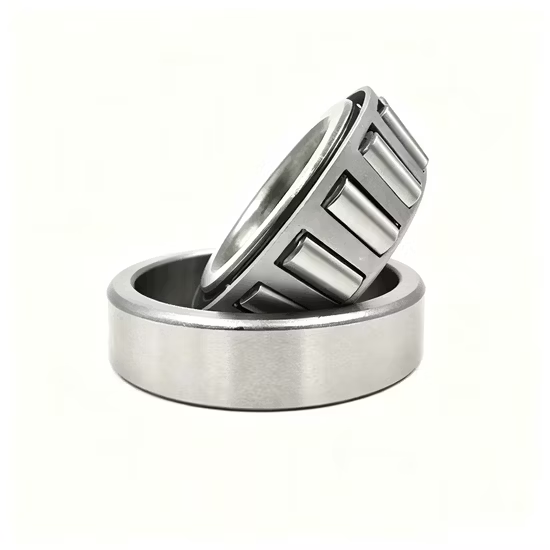
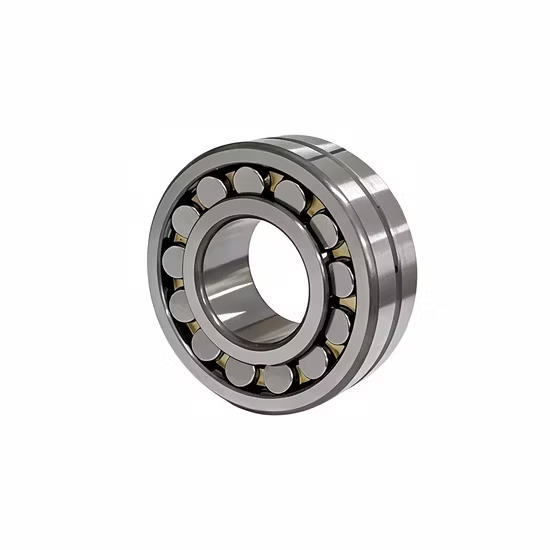
Cross-Reference Alignment Verified — We match internal clearances and material grades for extreme heat, not just base dimensions, preventing thermal binding in continuous casting lines.
Technical Specifications
| Parameter |
Value |
| Product Type |
High Temperature Steel Mill Bearings |
| Material |
Available in ceramic or stainless steel variants |
| Key Features |
Heat resistant, corrosion resistant |
| Certification |
Certificate of Conformity, material test reports |
| Customization |
Application-based selection for specific thermal loads |
| Origin |
Country-of-origin documentation provided |
Application Suitability
| Industry |
Typical Applications |
| Steel and Metallurgy |
Continuous casting machine segments, rolling mill work rolls |
| Furnace Equipment |
Hearth rollers, cooling bed transfer mechanisms |
| Metallurgical Machinery |
Ladle crane hoisting drums, descaling pump shafts |
Why Standard Bearings Seize in Rolling Mills and the Role of a Trusted high temperature ceramic steel mill bearing supplier
Thermal expansion miscalculations cause catastrophic binding long before the steel actually cools.
In heavy metallurgical environments, standard bearing steel rapidly loses its structural integrity when exposed to radiant heat from red-hot billets. I have witnessed continuous casting lines grind to a halt because a standard clearance bearing was installed where a high-temperature variant was required, leading to severe thermal binding and cage disintegration. Selecting the correct material and internal geometry is not optional; it is the only way to maintain operational continuity [NEED_CITE: rolling bearing failure mode classification per ISO 15243]. Working with an experienced high temperature ceramic steel mill bearing supplier ensures that the extreme thermal gradients of rolling and casting equipment are properly addressed during the selection phase.

Matching Material Options to Metallurgical Thermal Profiles
Determining the exact high temperature ceramic steel mill bearing supplier solution requires evaluating the specific thermal and corrosive loads of the equipment. Ceramic variants offer exceptional thermal stability and electrical insulation, making them ideal for areas with intense radiant heat and stray currents. Conversely, stainless steel options provide enhanced toughness and corrosion resistance for zones exposed to aggressive descaling fluids and heavy mechanical shock. Our engineering review ensures the chosen material aligns perfectly with the operational realities of your rolling or casting line.
Navigating Extreme Loads and Contamination in Casting Zones
Rolling mill and casting equipment subject bearings to immense radial loads combined with severe thermal cycling. At elevated temperatures, standard lubricants degrade rapidly, necessitating specialized high-temperature greases or solid lubricants to prevent metal-to-metal contact. Furthermore, the abundance of abrasive scale and cooling water demands robust sealing solutions that minimize friction while blocking contamination [NEED_CITE: bearing seal friction and contamination ingress trade-offs]. Proper clearance selection is equally critical; insufficient internal clearance leads to preload buildup as the inner ring expands faster than the outer ring under extreme heat.
Evaluating Material Boundaries and Selection Dimensions
The decision between ceramic, stainless steel, or specialized bearing steel hinges on the intersection of load capacity, speed, and ambient temperature. Ceramic rolling elements are noticeably lighter and exhibit considerably less thermal expansion than steel, reducing centrifugal forces and internal friction at higher speeds. Stainless steel variants maintain structural toughness under heavy shock loads where ceramic might be susceptible to brittle fracture under extreme impact. Understanding these material boundaries allows procurement teams to specify components that survive the harsh realities of furnace and casting environments without premature degradation.
The Hidden Financial Drain of Incorrect Material Specification
Installing a standard bearing in a high-temperature zone inevitably results in unplanned downtime and catastrophic damage to adjacent equipment components. When thermal binding occurs, the resulting friction can weld the bearing to the shaft, requiring extensive machining and prolonged production halts. According to failure analysis frameworks, a significant share of premature failures in metallurgical plants stems directly from ignoring the thermal limits of standard materials [NEED_CITE: impact of thermal degradation on bearing fatigue life per ISO 281]. These hidden costs far exceed the initial investment in properly specified high-temperature components.
Securing Reliability Through Authorized Technical Channels
Sourcing from an authorized channel guarantees that every high temperature ceramic steel mill bearing supplier order is backed by verifiable batch traceability. We prevent cross-reference errors by validating internal clearances and cage materials against your specific thermal requirements, rather than merely matching base dimensions. Our application-based selection review covers load, speed, and extreme temperature conditions to eliminate guesswork. Furthermore, we provide comprehensive documentation, ensuring that the components you receive are genuine and fully suited for the demanding metallurgical environment.
Documentation & Authenticity
- Certificate of Conformity verifying material grades for high-temperature metallurgical use.
- Full batch and lot traceability linking each bearing to the manufacturer’s production facilities.
- QR verification via brand official apps to confirm authenticity before installation.
- Material test reports validating the heat-resistant properties of ceramic or stainless steel variants.
- Dimensional and running accuracy inspection reports ensuring precise fitment in casting segments.
- Country-of-origin documentation for compliance with international procurement standards.
Storage, Handling & Mounting
- Store ceramic variants in original packaging to prevent edge chipping before mounting in rolling mills.
- Use dedicated clean gloves when handling stainless steel options to avoid carbon steel cross-contamination.
- Apply induction heating strictly within specified limits to preserve the heat-resistant material structure.
- Ensure high-temperature lubricants are applied immediately if open-type bearings are used in furnace zones.
- Verify internal clearance markings match the thermal expansion requirements of the casting equipment.
Initiating Your Technical Specification Review
To determine the precise bearing configuration for your equipment, please provide the specific machine model, available mounting space, and detailed operating parameters. Sharing data regarding radial and axial loads, rotational speeds, and exact ambient temperatures allows our engineering team to calculate the necessary internal clearances and select the optimal material variant. Detailing the environmental exposure, such as descaling water or radiant furnace heat, ensures we recommend the most effective sealing and lubrication strategy for your application.
Frequently Asked Questions
Q: How do we determine the exact bearing designation for our furnace equipment?
A: Provide your equipment model, mounting dimensions, and specific operating temperatures. Our engineering team evaluates these parameters alongside your load and speed requirements to identify the precise internal clearance and material variant needed, ensuring the selected component withstands the extreme thermal cycling of your furnace environment without binding.
Q: What are the common failure modes of standard bearings in high-temperature metallurgical applications?
A: Standard bearings typically suffer from thermal binding, rapid lubricant degradation, and cage disintegration when exposed to metallurgical heat. The inner ring expands excessively, eliminating internal clearance and causing severe friction. This leads to catastrophic seizure, often damaging the shaft and housing, which necessitates extensive downtime for replacement and machining.
Q: When should we choose ceramic over stainless steel for steel mill bearings?
A: Ceramic variants are preferred for applications involving intense radiant heat, high speeds, or stray electrical currents, as they offer superior thermal stability and insulation. Stainless steel is better suited for zones experiencing heavy mechanical shock loads and aggressive chemical exposure from descaling fluids, where the toughness of the metal is required to prevent brittle fracture.
Q: How can we source replacements if our original high-temperature bearings are discontinued?
A: Share the original equipment manufacturer part number and current operating conditions with our technical team. We perform a comprehensive cross-reference review that aligns internal design, high-temperature clearance, and material properties, identifying an authorized equivalent that matches or exceeds the performance of the discontinued component in your specific metallurgical application.
Q: What maintenance and lubrication practices are recommended for these high-temperature bearings?
A: Maintenance cycles must be adjusted to account for the rapid degradation of standard lubricants at elevated temperatures. Utilize specialized high-temperature greases or solid lubricants designed for metallurgical environments. Regularly inspect seals for scale ingress and monitor bearing temperature to detect early signs of thermal binding or lubrication failure before catastrophic seizure occurs.