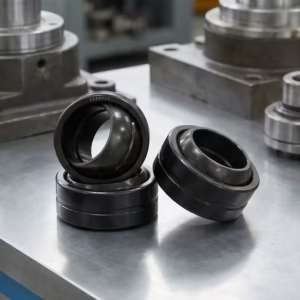
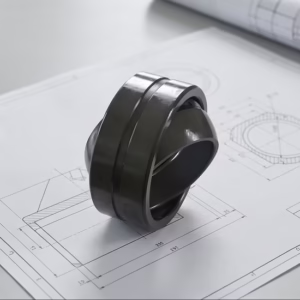
Cross-Reference Alignment — We verify thread type, material grade, and internal clearance simultaneously to ensure exact equipment compatibility.
Technical Specifications
| Parameter |
Value |
| Product Type |
Rod End Bearing |
| Material Options |
Stainless Steel |
| Surface Finish |
Polished |
| Feature |
Corrosion Resistant |
| Origin |
China |
Application Suitability
| Industry |
Typical Applications |
| Marine Equipment |
Deck crane articulation joints, steering gear linkages, winch control arms |
| Food Machinery |
Washdown conveyor pivots, packaging machine actuator arms, mixing vessel linkages |
Why Marine and Food Processing Environments Destroy Standard Spherical Joints
Standard carbon steel joints fail rapidly when exposed to saltwater or aggressive washdown chemicals, making the selection of a reliable stainless steel corrosion resistant rod end bearing supplier critical for long-term uptime.
Material mismatch in corrosive environments leads to rapid seizing and catastrophic linkage failure.
Operating in Dubai for years, I have seen the devastating impact of high humidity and salt exposure on moving parts. I once encountered a client who substituted standard carbon steel rod ends for stainless variants in a hydraulic arm application. Within three months, the inner rings rusted solid, causing complete system seizure and extensive downtime. Visual inspections often miss internal corrosion until the joint locks up entirely [NEED_CITE: rolling bearing failure mode classification per ISO 15243]. Protecting your equipment requires components specifically engineered to repel moisture and chemical attack without sacrificing articulation smoothness.

Matching Material Options to Aggressive Operating Conditions
Selecting the right material is the primary defense against environmental degradation. Stainless steel variants provide the necessary resistance to chloride-induced pitting and chemical oxidation found in marine and food-grade settings. The polished surface finish is not merely aesthetic; it actively reduces friction and prevents the accumulation of biological contaminants or salt deposits in sensitive machinery. When sourcing from a qualified stainless steel corrosion resistant rod end bearing supplier, buyers must ensure the material grade aligns with the specific chemical exposure of their application to maintain reliable articulation over time.
Navigating Washdown and Saltwater Articulation Challenges
Articulation joints in these sectors face a unique combination of oscillating movements and severe environmental exposure. In food processing, high-pressure washdowns force moisture into microscopic clearances, washing away standard lubricants and accelerating wear. Marine applications subject the joints to constant salt spray, which rapidly degrades unprotected surfaces. The oscillating nature of rod end movement means the lubricant film is continuously disrupted, requiring materials that can operate effectively even when boundary lubrication conditions occur. Proper sealing and material selection are therefore paramount to prevent moisture ingress and subsequent internal scoring [NEED_CITE: tribological challenges in oscillating bearing applications].
Evaluating Surface Finish and Material Selection
For application-oriented spherical joints, the base material dictates the operational lifespan. Stainless steel construction ensures long-term structural integrity in highly corrosive environments where standard bearing steel would rapidly deteriorate. The polished finish minimizes surface roughness, which is crucial for preventing microscopic crevices where bacteria or corrosive salts could accumulate. Selection dimensions must also consider the thread size, load capacity, and the specific environmental exposure to specify the correct variant. Understanding these material options allows engineers to balance corrosion resistance with the mechanical demands of the linkage system.
The Hidden Costs of Improper Material Substitution
Substituting specified stainless steel components with cheaper, coated carbon steel alternatives introduces severe operational risks. Once the protective coating is compromised by articulation friction, the underlying steel corrodes rapidly, leading to unplanned downtime and premature failure. In critical systems like deck cranes or food packaging lines, a seized joint can cause catastrophic damage to connected hydraulic or pneumatic actuators. Furthermore, using non-compliant materials in food machinery often results in warranty voidance and regulatory violations. Adhering to material specifications is essential to avoid these compounding financial and operational penalties [NEED_CITE: financial impact of unplanned downtime in heavy machinery].
Securing Traceability in Mixed-Brand Procurement
Sourcing mixed-brand requirements through a single authorized channel eliminates the coordination errors that often plague complex procurement. Cross-brand interchange must be matched on thread specification, material grade, and internal clearance, rather than just the basic designation. We provide batch traceability to the manufacturer with QR verification through brand official apps, ensuring every component is genuine. Our application-based selection review covers the specific load, speed, and temperature conditions of your marine or food processing equipment, preventing the costly mistake of installing a base-number match that lacks the correct internal design or material properties for the environment.
Documentation & Authenticity
- Certificate of Conformity confirming the specific stainless steel grade used in the housing and inner ring.
- Batch and lot traceability linking each rod end directly to the manufacturer’s production records.
- QR verification via brand official apps to instantly confirm authenticity and prevent soft-ring counterfeit installation.
- Material test report validating the chemical composition for marine and food-grade compliance.
- Dimensional and running accuracy inspection report verifying thread tolerances and spherical bore geometry.
- Country-of-origin documentation supporting customs clearance and regional import compliance.
Storage, Handling & Mounting
- Store in original packaging with strict humidity control to prevent surface condensation on the polished stainless steel finish.
- Use clean gloves during handling to avoid transferring acidic skin oils that could compromise the corrosion-resistant surface.
- Avoid using standard carbon steel tools during mounting to prevent cross-contamination and localized rust spots on the stainless housing.
- Apply specified food-grade or marine-grade lubricants to the articulation interface if the specific variant requires external replenishment.
- Verify thread engagement depth and alignment before applying final torque to prevent cross-threading and housing distortion.
Engineering Review and Selection Guidance
To ensure the selected rod end perfectly matches your equipment requirements, please provide the specific machine model, available installation space, and the exact radial and axial loads experienced during operation. Detailing the environmental conditions, such as the concentration of washdown chemicals or the level of saltwater exposure, allows our engineering team to determine the precise material grade and design variant needed. This technical review guarantees that the final selection delivers reliable performance and extended service life in your specific application.
Frequently Asked Questions
Q: How do I determine the exact rod end designation for my equipment?
A: Determining the correct designation requires evaluating the specific load profile, articulation angle, and thread requirements of your application. Provide your equipment parameters, including radial and axial loads, operating speeds, and environmental exposure. Our engineering team will review these factors to specify the exact material grade, thread type, and dimensional variant required for optimal performance and longevity.
Q: What are the common failure modes of spherical joints in marine environments?
A: In marine environments, the most frequent failure modes include chloride-induced pitting, crevice corrosion, and lubricant washout leading to metal-to-metal contact. Oscillating movements disrupt the lubricant film, accelerating wear when moisture penetrates the articulation interface. Selecting components with appropriate stainless steel construction and polished finishes mitigates these specific degradation mechanisms effectively.
Q: How does stainless steel compare to coated bearing steel for corrosive applications?
A: Stainless steel provides inherent, throughout-the-body corrosion resistance, whereas coated bearing steel relies on a surface layer that can wear away during articulation. Once the coating on standard steel is compromised, the underlying material corrodes rapidly. Stainless variants maintain their protective properties even when subjected to continuous friction and aggressive chemical washdowns.
Q: How can I verify the authenticity of the bearings upon delivery?
A: Authenticity is verified through batch and lot traceability documentation provided with every shipment. You can scan the QR codes on the packaging using the brand’s official mobile application to confirm the origin and manufacturing details. This process ensures you receive genuine components and protects your equipment from the risks associated with counterfeit soft-ring failures.

![Stainless Steel Rod End Bearing Corrosion Resistant Spherical Joint [WARN] draft identifier mismatch](https://skfsale.com/wp-content/uploads/2026/10/stainless-steel-rod-end-bearing-corrosion-resistant-spherical-joint-warn-draft-identifier-mismatch-3efceb.avif)
![Custom Spherical Plain Joint Bearing Gcr15 Stainless Steel OEM [WARN] draft identifier mismatch](https://skfsale.com/wp-content/uploads/2026/10/custom-spherical-plain-joint-bearing-gcr15-stainless-steel-oem-warn-draft-identifier-mismatch-84597e-300x300.avif)